



Religious diversity in the world/ Where does Albania stand on the global map of religions?

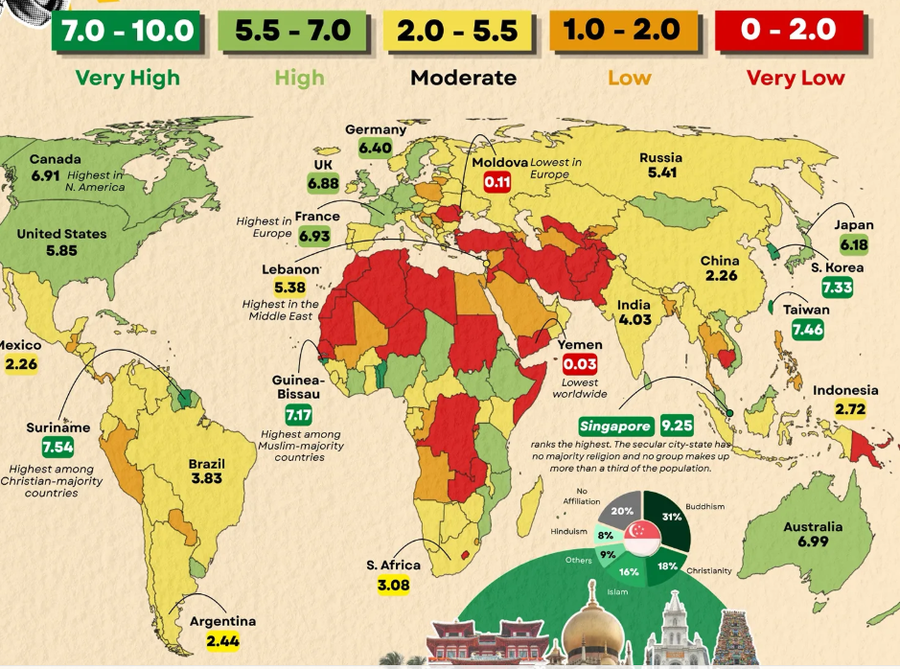
Religious diversity in the world presents a very diverse picture, ranging from societies where several faiths coexist in a balanced way, to countries where a single religion dominates almost completely. To measure this distribution, the Pew Research Center has constructed the Religious Diversity Index (RDI), which includes 201 countries and assesses how evenly the spread of beliefs is within a population. The higher the score, the greater the religious diversity is considered.
According to data published by Visual Capitalist, Albania ranks 61st in the world for religious diversity, with a score of 4.75 points. This position places the country in an average category, reflecting a religious structure where several important faiths exist.
A more concrete picture of this structure is provided by the Population Census data. According to them, around 1.1 million citizens in Albania identify as Muslim believers, constituting the largest religious group in the country. In second place is the Catholic religion, with around 201 thousand believers, while the Orthodox community numbers around 173 thousand people. Alongside them, there are also smaller communities such as the Bektashis, Evangelicals and other believers, who contribute to the country's religious mosaic but in smaller numbers.
A striking element in the case of Albania is the relatively high number of individuals who do not have a clear religious identification. Around 332 thousand people have declared themselves as unqualified believers, while nearly 244 thousand have not preferred to declare their religious affiliation.
Globally, Singapore tops the list for religious diversity, representing one of the most balanced societies in this regard. In this country, no single religion accounts for more than a third of the population, while a mix of Buddhism, Christianity, Islam, Hinduism and other groups creates a rare balance.
Countries like Suriname and Taiwan also rank among the most diverse, with several faiths coexisting relatively equally. These countries often share histories influenced by migration, international trade, and colonialism, factors that have led to a wide mix of religious identities.
At the other end of the spectrum are countries like Yemen and Afghanistan, where religious diversity is minimal. In these countries, a single religion accounts for almost the entire population, significantly reducing the diversity index. This situation is related not only to historical traditions, but also to low levels of migration and a high level of ethnic and cultural homogeneity.
In general, countries with high religious diversity share several common characteristics, such as more open policies towards migration, stronger legal protections for religious freedom, and developed urban and commercial histories. These factors create conditions for continuous interaction between different cultures and religions, directly influencing the growth of diversity.
In this context, Albania presents itself as an interesting case, a country with a tradition of religious coexistence and tolerance, but which does not reflect a completely balanced distribution of beliefs.

Food remains expensive/ Fish and meat with the strongest price increase
Tensions in the Middle East have begun to be reflected in the Albanian market, mainly through increased transportation costs, keeping the prices of food and......
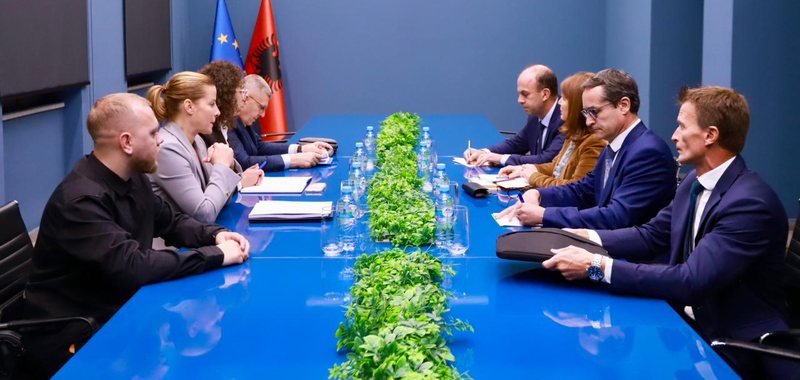
France assists Albania in the recovery and management of organized crime assets
The Agency for the Administration of Sequestered and Confiscated Assets (AAPSK) held a working meeting with representatives of AGRASC, the French Agency for......

Cooperation between the State Police and the Albanian Road Safety Agency is intensified to increase road safety
The Director General of the State Police, Major General Skender Hita, accompanied by the Director of the Department of Public Order and Security and the......
The Transparency Board increases fuel prices, diesel goes to 197 lek/liter
The Transparency Board has published this Friday the new fuel prices in the domestic market, reflecting a slight increase compared to the previous day. The......
DPSHTRR removes 2000 old vehicles from circulation - In the period January-April, 126 thousand technical inspections of vehicles were carried out
The General Directorate of Road Transport Services has published the technical inspection data of vehicles that underwent testing at Technical Inspection......
Albania and the EU, from negotiations to weight in the economy/ While accession negotiations continue, the Union remains the most important partner
From the establishment of diplomatic relations with the European Community in 1991, to the opening of membership negotiations and the process of negotiating......
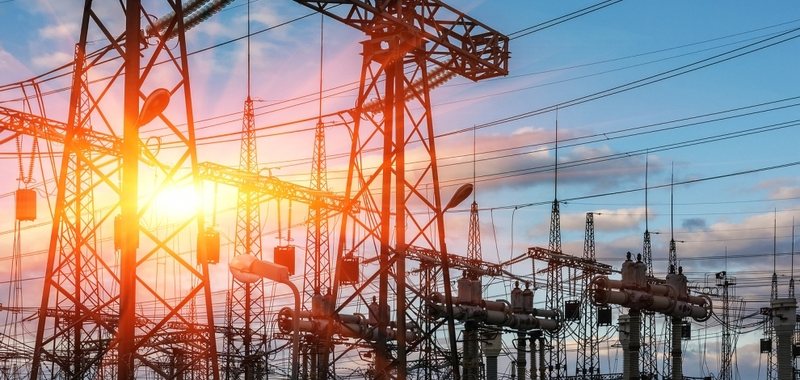
New power plants produced 2.43% of energy - ERE: 262 MW of capacity was added in 2025, solar energy dominates
Around 262 MW of new capacity from renewable sources has been added to the Albanian electricity system during 2025, with solar energy clearly dominating,......
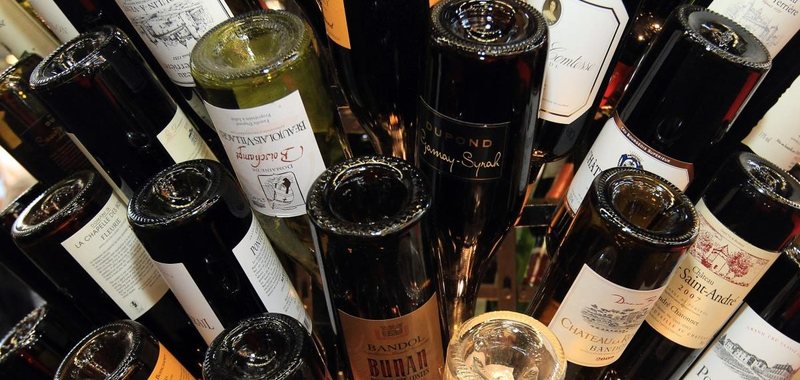
Albanian Customs and the Italian Customs Agency agree on a technical solution to the problem of wine imports from the neighboring country
Italian Customs have notified the Director General of Albanian Customs, Besmir Beja, of the acceptance of the proposal to resolve the current situation......