



The war "saved" Albanian exports/ They recorded a 16.9% increase in April, the trade deficit improved

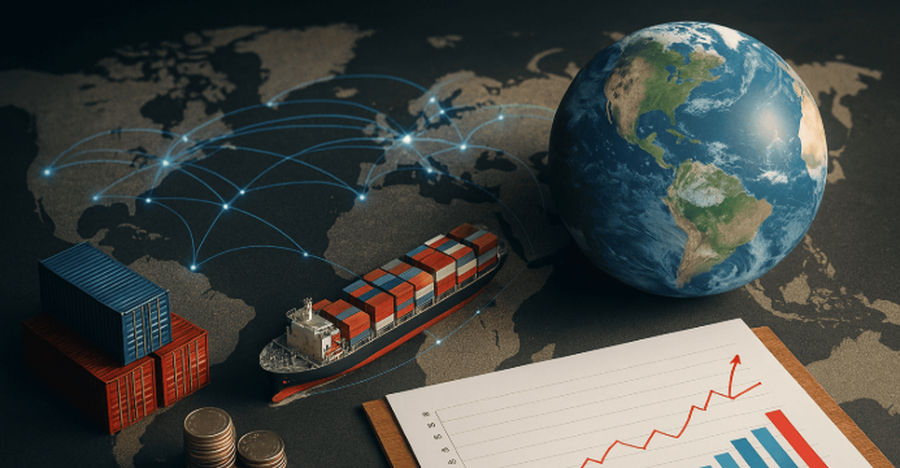
Exports of goods recorded strong growth in April, narrowing the trade deficit at the same time, while the impact of energy prices and tensions in the Middle East continues to be reflected in Albanian foreign trade.
According to official INSTAT data, in April 2026 exports reached 34.9 billion lek, increasing by 16.9% compared to the same month a year earlier and by 6.8% compared to March. Imports reached 79 billion lek, with a more moderate increase of 4.4% in annual terms, while falling by 1.6% compared to the previous month. As a result, the trade deficit decreased to 44.1 billion lek, with a contraction of 3.8% compared to April last year.
The growth in exports was mainly supported by the group “Minerals, fuels and electricity”, which made the largest positive contribution with 9.8 percentage points, followed by construction materials and metals with 6.6 percentage points. Food, beverages and tobacco, as well as machinery and equipment also contributed to the growth.
“The impact of international prices appears particularly strong in the minerals, fuels and electricity group. The data show that, although the weight of imports in this group fell to around 193 million kg from 206 million kg a year earlier, the value increased to 9.6 billion lek from 7.7 billion lek. The same trend was also evident in exports, where the quantity fell from 227 million kg to 216 million kg, while the value increased significantly to 8.4 billion lek. This suggests that the growth in trade in this category has been driven mainly by higher energy and fuel prices in international markets, at a time when tensions in the Middle East continue to keep global energy markets unstable.”
Meanwhile, traditional sectors continue to show weaker signals. Textiles and footwear contributed negatively by 1.8 percentage points, while chemical and plastic products, as well as leather and leather goods, had a more limited negative impact.
Even in imports, the main impact was provided by minerals, fuels and electricity with 2.5 percentage points, followed by food, beverages and tobacco with 2.1 percentage points. On the other hand, machinery, equipment and spare parts had a negative impact, partially curbing the expansion of imports.
Unlike March, when imports expanded at a much higher pace, April saw a slowdown in foreign purchases, which helped reduce the trade deficit. However, the high dependence on energy and fuel imports continues to keep the Albanian economy exposed to developments in international markets and transport costs.
In terms of partner markets, Albanian exports recorded the highest growth towards Kosovo with 26% and Germany with 28.9%, while they fell towards Italy with 3.8% and Spain with 20.6%. On the other hand, imports increased mainly from China with 18.9% and Italy with 3.1%, while they fell from Germany and Turkey.
Construction of Road Corridor VIII - 2 expropriation decisions approved, paving the way for the continuation of works
The government has approved two expropriation decisions for the construction of Corridor VIII, paving the way for the continuation of works in the Elbasan -......

Trade dominates new businesses - Over 15 thousand enterprises were registered in 4 months
Retail and wholesale trade appears to be becoming the dominant sector of the Albanian economy in terms of new business openings. Stores, service activities,......

Fluctuations in the foreign exchange market – Dollar weakens. Franc and Pound gain points
The US dollar, after a continuous increase recorded throughout the past week, has suffered a slight decline in its value this morning, being bought today at......

Self-Employment Program, call for applications - Best plans until June 4. Financing up to 1 million lek
The National Employment and Skills Agency calls on all unemployed job seekers who have a business idea to apply to the Self-Employment Program, a concrete......
"Abandon the stability pact" - Meloni's request to the European Commission has been rejected
The exemption from the Stability Pact should apply not only to defense, but also to the energy crisis. This is the request of Prime Minister Giorgia Meloni,......
Card payments and ATMs, new transparency rules - Banks to inform customers about the difference between the applied and official exchange rate
Albanian citizens are expected to have more information and transparency about the real costs of payments and foreign exchange. The Bank of Albania has......
Energy crisis brings back lignite - Many countries are expected to use it after gas prices rise
The closure of the Strait of Hormuz, which has caused major problems in the transportation of natural gas and crude oil, which are also used to a large......

Global companies lost $25 billion from the war - Most are based in the UK and Europe
The US-Israeli war with Iran has already cost companies around the world at least $25 billion and the bill is rising, according to a Reuters analysis.......