



Interview/Agreements with Greece and developments in Albania, Rama in front of the editor-in-chief of the newspaper 'Kathimerini'

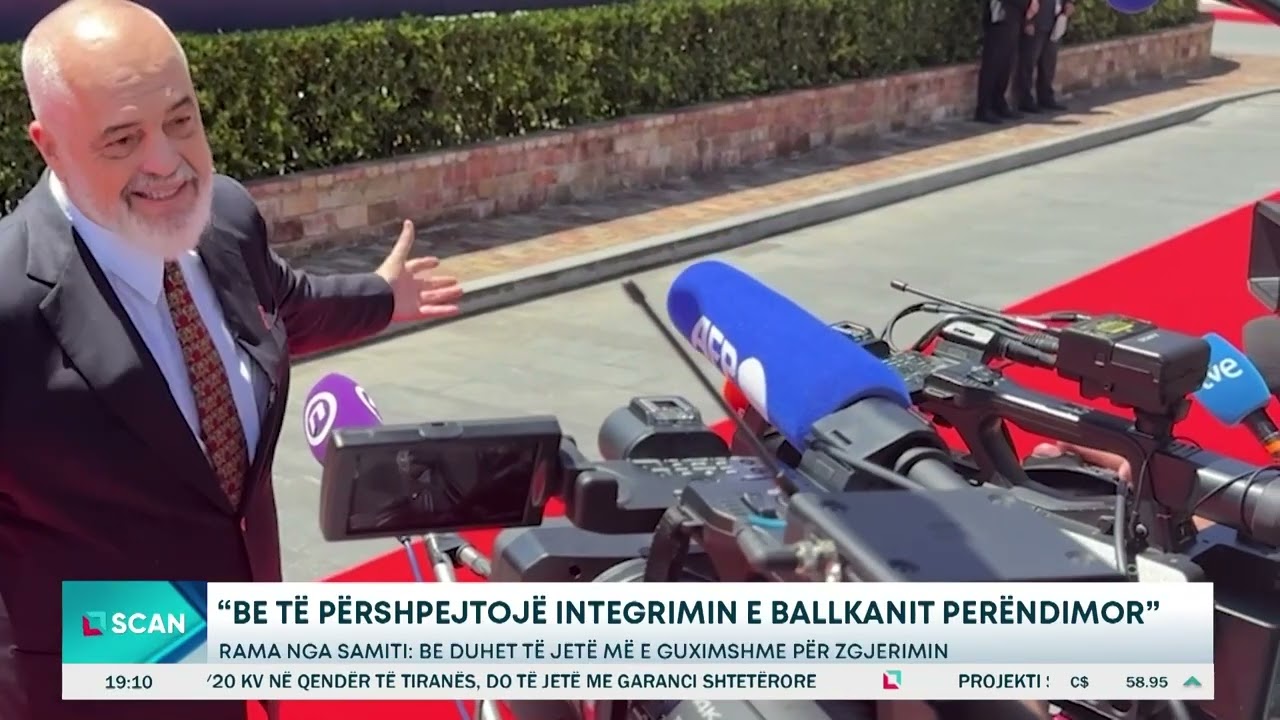
As part of his participation in the 11th Meeting of the Delphi Economic Forum, in Greece, Prime Minister Rama held a conversation with Alexis Papahelas, Editor-in-Chief of the Kathimerini newspaper.
Below is the full interview:
Alexis Papahelas, Editor-in-Chief of the Kathimerini newspaper: Greetings to everyone! Mr. Prime Minister, it is a pleasure to have you here.
Prime Minister Edi Rama: Kalispera!
-Ah, this is the third Greek word besides Efkaristo and Sagapo poli. What was the other one?
Prime Minister Edi Rama: Kalispera and Kalimera.
- Okay, okay. We're not bad. I was telling you this morning when I saw you with the Greek Prime Minister, how many Greek Prime Ministers have you met during your mandate?
Prime Minister Edi Rama: I think I also met Prime Minister Simitis, but I was not in this position, I was Minister of Culture. Then I met Prime Minister Karamanlis when I was Mayor, I met Prime Minister Papandreou, Prime Minister Samaras, I met everyone.
- So you have a collection. What about the president, Turk? How much?
Prime Minister Edi Rama: One and only.
-Let me ask you, we are experiencing a period of geopolitical turmoil, so to speak. How does a country like Albania deal with this?
Prime Minister Edi Rama: Listen, when you are as small as Albania, on the one hand you have to deal with what you have to, but on the other hand you are also relaxed, because you cannot change anything, whether for better or for worse. So, whatever comes, let it come. Yes, we are members of NATO. Yes, however, it is not that we put a lot of things there. When NATO does something good, like for example, liberating Kosovo, we say we have done a great thing. When NATO does something bad, like for example leaving Afghanistan, as they did, we say it is their fault, because the big ones take the blame, the small ones, they can also take some credit when it is to be taken.
-However, do you have the feeling that the Balkans are a forgotten neighborhood in this landscape?
Prime Minister Edi Rama: No, I don't think the Balkans are forgotten. I have the feeling that we are in the best of times. To be very clear, the Western Balkans, we are in the best of times, we have never been closer to the European Union. The European Union has never been so aware of our importance in the entire geopolitical geo-landscape. We have much more visibility, so in many ways.
Over the last decade it has become normal, but it has not been normal at all for us to talk and cooperate with each other. I want to remind you that we, all six leaders of the Western Balkans, sat around the same table only in 2014 in Berlin for the first time in history. So no, we are not forgotten, we are in the best time we have ever lived.
-But I remember that last time you asked President Trump, I remember last February you gave a speech where you asked him to get involved in some of the conflicts that are happening.
Prime Minister Edi Rama: Yes, I had the privilege of being with President Trump on the day of the establishment of the Peace Board and I told him something that is very dear to my heart and has to do with law, international justice and specifically with the International Court of Justice that was created, based on a fantasy report, sponsored by the Russians, by Vladimir Putin's delegation to the Council of Europe, which supported a motion to investigate the so-called crimes of the Kosovo Liberation Army and specifically human organ trafficking.
The court was set up to turn this fantasy report into a trial against a leader and they took a president who was actively serving from office and brought him to The Hague and imprisoned him on formal charges and the Speaker of Parliament as well and then the whole process turned into something completely different. So there was no human organ trafficking and they are practically accused of leading the rebellion against the occupiers and collaborating with NATO. That is the essence practically. I told President Trump that this is something that he needs to know and hopefully can intervene in.
Have you received any response?
Prime Minister Edi Rama: He hasn't informed me yet. He's been very busy, I wonder.
- Okay, I want to talk a little bit about Albania's European aspirations. Albania is a bit of a paradox to me because on the one hand you have a significant rate of growth, but on the other hand almost 500 thousand, so half a million people have left the country during your mandate. How do you explain this paradox?
Prime Minister Edi Rama: First of all, half a million is not an exact figure, but yes, Albanians have continued to leave and I think it is the most normal thing for a country that has gone through 50 years of complete isolation and for people who have always been inclined to emigrate and seek a better life. But on the other hand, I think there is clear data that Albanians are also returning. So we are still in a net negative between people leaving and coming, but the gap is narrowing and yes, we must continue to do a lot, but just to give you a figure. When I took office, our GDP was less than 10 billion euros, while currently it is 27 billion euros, so we have done a lot. We used to count 2 million tourists, while last year we increased to 12 million tourists. We had 300-400 million foreign direct investments, while last year we reached 1.6 billion, so these are important figures for a country like ours. Of course, there is no doubt that there is much to be done for people.
- Every report I read in the context of the European aspiration has criticisms about the informal economy that is still 1/3 of GDP and the issues of the rule of law. Are you dealing with them?
Prime Minister Edi Rama: Of course we are dealing with it. And the reason is because every year and I just saw the figures for the first four months, we are at about 300 million euros more in revenue, compared to last year and about 100 million above the planned value and it is not only growth, but it is also the narrowing of the space of the informal economy because we have also put artificial intelligence into action, digital tracking, and so on, it is a battle.
When it comes to the rule of law, the rule of law, of course we have problems and we are doing everything we can to improve in this regard. A journalist from “Politico” asked me: - Will you finish the work on the rule of law by 2027? I said, if you aim to be a member of the European Union, you have to understand that the work on the rule of law is never finished. It is an eternal motto. Are we improving? Yes, definitely. Yes, there is no such thing as finishing.
-There is also criticism that organized crime is a factor in Albania. Is this an uphill battle?
Prime Minister Edi Rama: Yes, I know. It is a criticism and in my view disproportionate, it is difficult to accept such criticism, when it goes beyond the dimensions, especially in the media even those that are abroad, because when you see our port, and when you see Barcelona, Antwerp or Rotterdam, the dimensions and what circulates in these ports is extraordinary, but this does not mean that we do not have problems. We have fought hard, we have achieved a lot of success, because finally we have succeeded in something that for us is the achievement of a lifetime, to give the judiciary its independence. Having an independent justice that is committed, that is much more committed against organized crime, has made the difference.
-I will talk about some of the bilateral issues now.
Prime Minister Edi Rama: Why do we have bilateral issues?
- Some.
Prime Minister Edi Rama: I don't think so.
- Maybe we can solve them here. We would be very happy.
Prime Minister Edi Rama: We had an issue a few weeks ago where everyone got into a fight because I said you are not Plato's grandchildren, but it was just a way to warm up the atmosphere in a debate with your colleague, not to diminish the values and beauty of Greek culture and history. So, I don't think such issues are very serious.
-I actually want to talk to you about this because you were with my friend John Defterios.
Prime Minister Edi Rama: He is a great person and I didn't want to make him feel like I was taking Plato and making him Albanian. It was just to tease him a little because in this part of the world we take ourselves very seriously and the only problem I have with Greeks and Albanians by the way, more with Albanians than with Greeks is taking ourselves very seriously, we think of ourselves as if we are something, that's all.
- But the other side is that we have to be very sensitive to each other's history and respect each other's history. I know what we're saying, calmly, take things as they come, but in the meantime it was like a kind of hostility.
Prime Minister Edi Rama: Not far from any hostility. Anyone who knows me, I have a great admiration for this country and I don't know, it seems to me that Thomas Miller who said that it takes a lifetime to discover Greece, but it takes a day to fall in love with it. And I haven't spent a day, but more than a day. And every time I come I feel that I have fallen in love with this country. How can I be hostile?
-Maybe it was a bad moment.
Prime Minister Edi Rama: No, it wasn't a bad moment. It was just me making fun of very serious people. Maybe I wasn't in the right place.
-Okay, I want to talk a little bit about resolving the property issue. One of the criticisms is that you have addressed it at the national level, you have achieved a 60% success rate at the national level. But when it comes to local areas where Greeks have roots and live there, these rates are much lower. How do you explain this?
Prime Minister Edi Rama: Listen. It's a very simple topic, but also complicated. You have to understand or rather remember that we were a country that was completely deprived of private property. For half a century we had no private property. We were not allowed to own a single square meter of land or even a private vehicle. After 50 years, we finally changed that terrible regime and of course property was the main issue. At that time, a law was passed with the consensus of both the opposition and the party that came from the past to give a use letter, that is, a use title, not a property title, to all those who worked the land and in the meantime to see and treat the former owners. At that moment, an overlap was immediately created and over the years, people who had land use titles became owners. Owners became former owners and a third layer was established, which were many people who came from rural areas and in a vacuum built illegally wherever they could on agricultural land. Of course, there was no other way but to legalize them. So there was a third layer.
We have been dealing with this for 10 years, cleaning up as much as we can, digitizing and so on, but to cut a long story short, no one can prove the opposite of what I am telling you, that the problem with property even in areas where there are ethnic Greek citizens is no different from the problems that ethnic Albanian citizens have in the same area or anywhere else.
It is simply an Albanian problem, for Albanians and for ethnic Greek citizens, which we are dealing with. And because we have a very important level of understanding and respect for the Greek minority and when I talk about understanding, understanding that it is a cultural treasure and in respect because they are citizens of our country, we have paid special attention to them and here I also want to congratulate Mr. Mitsotakis, who has been really persistent about this and I have considered this a good thing. Respect for him because he fights for his citizens, but at the same time I have told our people that we must respect this and we must do more because it is sensitive and we must show and prove to our neighbors how much we value this relationship.
- Will you provide us with data on how many requests for property by Greek citizens have been fulfilled?
Prime Minister Edi Rama: Listen, you are at the head of a very large newspaper and you send journalists to us. They can come and get all the information and it would be of great value also for the Greek audience if you do an accurate report based on the facts that we will make available to you and I think that this will help.
- Okay, we'll send someone there. Let's go to Beleri.
Prime Minister Edi Rama: To whom?
-To Fredi Beleri.
Prime Minister Edi Rama: Why should we go back to him? He is happy, he is a member of the European Parliament. For him, everything ended in such a way that every mayor who has been put in detention would have a dream, but in the meantime they continue to be in prison. No, I am serious. Today I have proof that at that time it seemed like a unique case and I have tried to explain to my dear friend Kyriakos from the Greek side who was very sensitive to this and I fully respect that this is something that has to do with a model in our country, after the justice reform, where detention in detention is becoming a problem and I can share it with you. I am not proud of this, but the judiciary is independent and we must deal with this with patience.
In Albania today we have 58% of people in prison who have not yet had a court proceeding, have not had a trial. And the mayor of Tirana, from my party that has no connection with Greece, had a relationship because he was very good friends with the mayor of Athens, he was imprisoned in January 2025 and is still in prison and the court process has just begun.
So, when I said that for Beleri it ended wonderfully because he is a member of the European Parliament, I mean that it ended, I don't want to go back to this thing and I already have proof that this is not something that only affected an ethnic Greek.
It is something that has affected many people and I can count other mayors who have faced this.
- Let me ask you so I understand. With ''Kathimerini'' you said that this was an unfortunate episode..
Prime Minister Edi Rama: It is unfortunate for him and for everyone who is actually facing trial and being detained and this is something that I do not take lightly. It is something that I am sharing with European friends, but I have been told ''this has to do with justice''. So I cannot comment. However, it is definitely an unfortunate episode.
-There is a discussion between the two countries regarding exclusive economic zones. Was there an agreement? Were you against it when you were in opposition? And then in 2020 you said you were ready to negotiate with Greece and take it to the International Court of Justice. Or is something happening on this front or what?
Prime Minister Edi Rama: The truth is more nuanced. It wasn't that I was against this, but after the agreement was made public, a military figure came out with a full article full of criticism and this ignited the environment because it's not just here, it doesn't just happen here that there's an immediate reaction when there's something to do with the other side, but it happens there too.
At that time we were in opposition and I said, ''listen, this may seem like a great gift that we can take, we can go to parliament, we can go to protests and we can call it "treason", but this is not what we should do and what we will do, because we are not that kind of party, but at the same time we cannot sit idly by, so we will take it to the Constitutional Court and it is up to the Constitutional Court to decide''.
So, we took it out of this ''football field'' between the parties and the ''fans'' and took it there. That's how it worked. We already have an agreement with the Greek government to go to the International Court of Justice. That's how it will be done and then it's up to the court to decide.
-Are we expecting any news, any agreement soon on this front?
Prime Minister Edi Rama: Listen, the Beleri issue created some difficulties in our relationship. There is no doubt and this was another unintended consequence of what happened. But what has been characteristic in my relationship with Kyriakos is that we have always been respectful of each other and open with each other without making a fuss.
I respect him a lot for that. We decided, we decided a long time ago that we should not let our countries be "devoured" by this kind of, this kind of fights, quarrels because something happened here or something happened there. We need to, once and for all, resolve all the issues that exist between us, and that's what we are doing.
Our ambition is to finish it within this year and that next fall, we declare that we have agreement on all issues. Minister Gerapetritis who is here and I salute him and I really admire his graceful manner. He is always graceful even in the most difficult moments, he has a graceful smile, an extraordinary professor of law. He has engaged with my Foreign Minister and we are very confident. From our side we do not see any issues. So, for us there is no problem on this issue.
Of course we have the still unresolved issue of martial law. We want it to be gone, to go away and we have no other problems and we have something that is a great asset for us, which is the Greek minority and also something else that is a great great asset for you, which are the Albanian citizens who live here, who are very much and already fully integrated. So we owe it to both sides to have a friendly relationship.
-So, do you expect there to be a resumption of resolving these issues?
Prime Minister Edi Rama: No no, I don't expect a restart because we have restarted. We expect an end, at the end of the year. We both expect an end at the end of the year. We hope because we never know. You never know what happens in this world. You never know what happens between us. You see? I'm trying to be careful not to joke with you, precisely because I don't want to disturb this peaceful environment that we have created.
- Is Alexander the Great Greek?
Prime Minister Edi Rama: What is it?
-Is Alexander the Great Greek? No kidding, please. It's not funny. I want to talk about energy. Will Albania become an entry point for gas, for Europe. Is there such a discussion?
Prime Minister Edi Rama: Now, I did not ask the US ambassador here for permission to provide any information, but I can speak without the permission of the Greeks, without the permission of the Europeans, but I cannot speak without the permission of the Americans, because they could get very nasty.
-Maybe it's the other way around.
Prime Minister Edi Rama: Yes, yes. There is a kind of conspiracy to make Albania. In fact, I like it very, very much when everyone in the region says we want to be the center of this, the center of that and in fact there without any thought is the idea to ''swallow'' everyone, but no. We do not want to swallow everyone. We have the chance to have this and our American friends are interested, they are quite helpful and on the other hand we are very happy that we have engaged in a genuine conversation with Greece, on energy issues that has been going on for some time.
- Another issue that has been discussed is that you have many Iranian dissidents in Albania. What?
Prime Minister Edi Rama: Look, we have a history, we still have to call on history. We have a history of hospitality that we want to preserve and nurture. As you may know, Albania is the only country in Europe, and for this reason we are unique, that ended World War II with more Jews than there were before this war began.
And there are no figures given for any Jews surrendered to the Nazis. We also protected 25,000 Italians, part of the occupying army when Italy capitulated, so we protected them from the Nazis; we welcomed the Afghans after that evacuation from Kabul happened in a way that is, how can we say, shameful. We opened the doors to several thousand Afghans, whom no one in Europe wanted.
As for the Iranians, we were asked to consider bringing them there not to use Albania as a platform for political opposition, but for humanitarian reasons, because they were in Camp ''Liberia'' in Iraq and were being attacked all the time by the murderers of Tehran. So we said yes, they can come.
We've had them for years and we've saved their lives. I think there will be a consideration to ''bring Albania into heaven'' if we tell all these stories when we've saved lives. So it's a way of thinking that somehow we can escape hell.
- Another question because I think the Prime Minister is coming. There is a lot of speculation about European refugee camps in Albania. Is there a discussion about this?
Prime Minister Edi Rama: European migration camps? Italian! No no, they are two different things for us. We have a ''long love story'' with Italy, so it is different. No, Italy asked us to consider, to offer them the opportunity to set up these centers for immigrants and we said yes, because we always say yes to Italy. They don't ask us for many things, but when they ask us, we say yes, because they have been very good to us and have been by our side in very difficult moments. So it is a special bonus. Of course then when the Italian Prime Minister is a woman, it is even more impossible.
- We've seen the photos of your love story.
Prime Minister Edi Rama: It's impossible for you to say no. Do you understand that?
- I understand that this also happened with the former Greek ambassador to Tirana, right?
Prime Minister Edi Rama: Yes, yes to anyone, yes especially to the Italian Prime Minister.
- Thank you very much, Prime Minister.
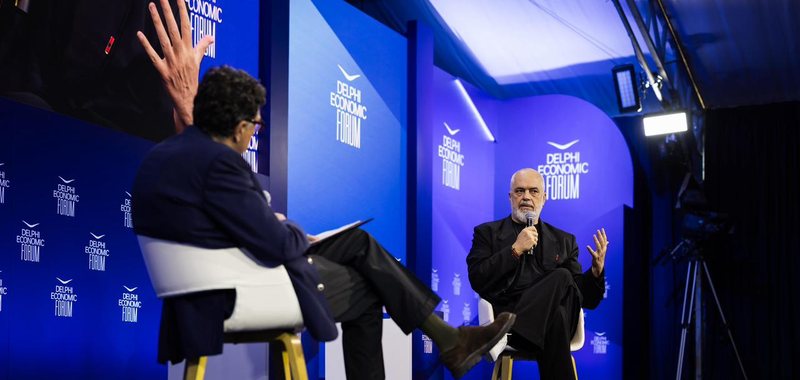
Albania, the European gas gateway? Rama at the Delphi Forum: We are cooperating with the Americans
Prime Minister Edi Rama from the Delphi Economic Forum had a conversation with Alexis Papahelas, editor-in-chief of the Kathimerini newspaper. Rama spoke......
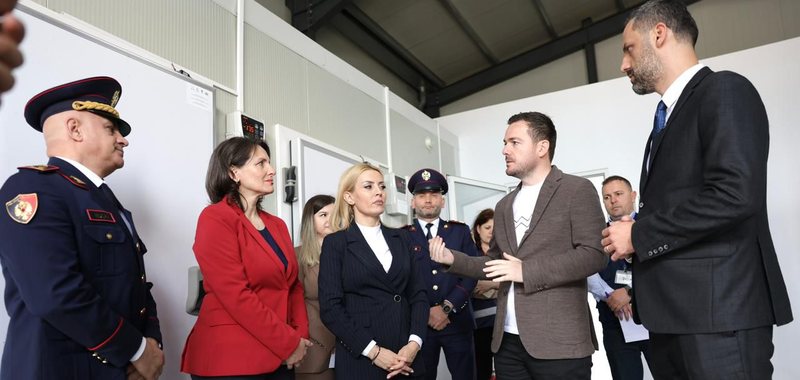
Food safety, Ministers Salla and Lamallari inspect the checkpoint at the Port of Durres
The Minister of Agriculture and Rural Development, Andis Salla, together with the Minister of Interior, Besfort Lamallari, conducted an inspection at the......

Innovation and finance in focus/ “Investing for Impact Forum 2026” takes place in Albania
The Ministry of Economy and Innovation, in collaboration with INNVEST and Visa, organized the "Investing for Impact Forum 2026", which brought together......
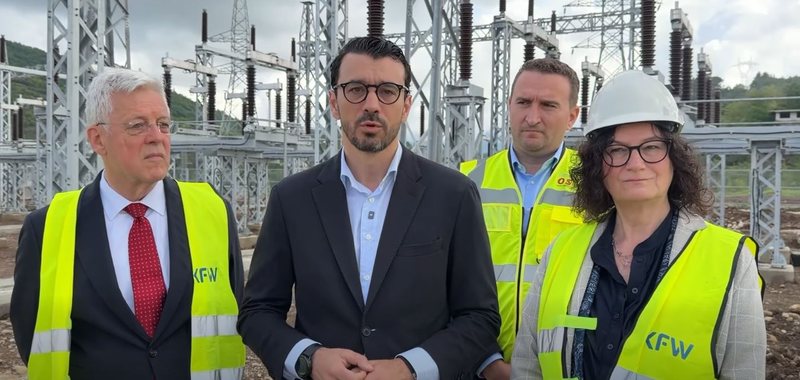
Strengthening energy security in Tirana - Karakaçi: Substation "Tirana 3" nearing completion, investments in other areas as well
The Minister of Infrastructure and Energy, Enea Karakaçi, inspected the construction works for the “Tirana 3” electrical substation in the Petrela area, an......
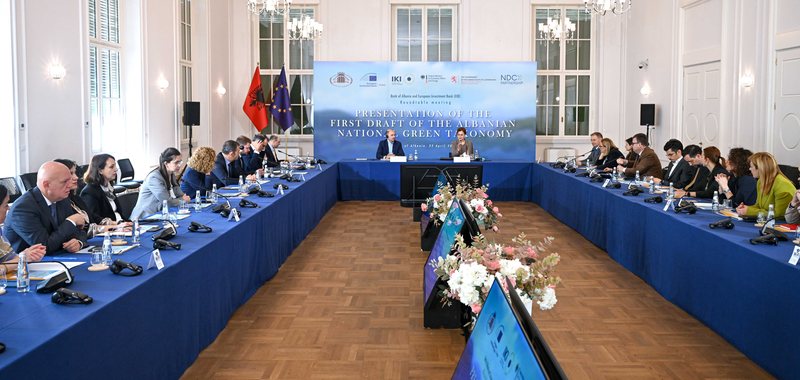
Financial market transparency, Bank of Albania presents the first draft of the Green Taxonomy
The Bank of Albania, in cooperation with the European Investment Bank (EIB), held today a technical and inter-institutional workshop in the framework of the......
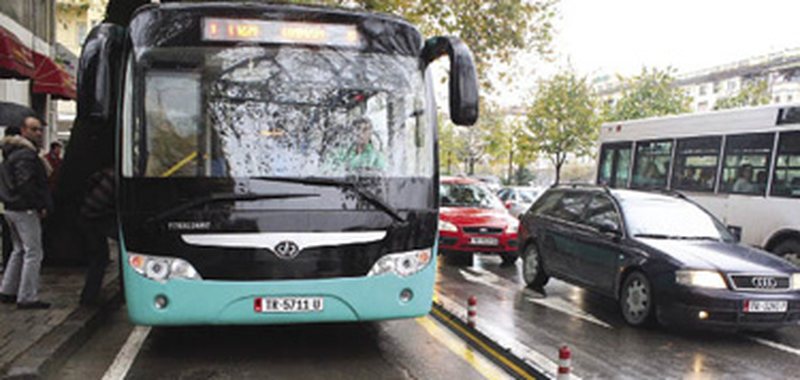
250 million lek for public transport - Tirana Municipality and government share the fuel compensation bill
The increase in fuel prices has forced institutions to intervene financially to support the public transport sector. According to the document drafted by the......

How do young people who live alone cope? - Radonshiqi: They turn to family for additional income
Living alone is becoming increasingly common in Tirana, but also more expensive. From rent to monthly bills and food, an individual faces almost the same......
The accreditation package for the IPARD III program is closed/ The Ministry of Finance advances in the process of opening the funds
The Ministry of Finance successfully completed the preparation of the accreditation package for the IPARD III Programme, marking an important step towards......